VAGUE Fashion Week SS26 Report
In our first edition of the VAGUE Fashion Week report, we discuss the creative director shuffle as the perfect breeding ground for fashion’s move beyond aesthetics and into (re)building concrete brand universes.

The Spring/Summer 2026 season revealed itself not simply as a series of aesthetic gestures but as a moment of structural change, at the heart of which was one urgent question: what happens when fashion’s most storied names are asked to reinvent themselves?
Across London, Paris and Milan, where this report narrows, the runway was framed by an almost palpable anxiety. A reported 16 creative‑director debuts were set to alter the landscape from within, forcing brands and audiences alike into a rare moment of re-alignment. The appointment of any new designer at a legacy maison means balancing institutional heritage with personal vision. But this many musical chairs meant this season’s collections couldn’t just be about the expression of creativity or interpretation of house codes; they also had to satiate public perception (and articulation, if the rise of fashion commentators dotting the front row was anything to go by) of these designers’ competence, relevance and ultimately, their survival.
Into this charged milieu, a number of newly incumbent designers — some emerging, some firmly in the luxury brand fold — staged collections that felt like tests of legitimacy in some cases, entire recalibrations of identity in others. By contrast, the work of emerging designers such as Dilara Findikoglu or Yaku, unaffected by the changing of the guard, may at first glance seem disparate from the turbulence. But what united them all was a renewed willingness to lean into world-building — myth, survival, transformation — in a season when the industry itself was desperate for new narratives.
“A number of newly incumbent designers [...] staged collections that felt like tests of legitimacy in some cases, entire recalibrations of identity in others.”
Yaku’s presentation combined layered outerwear, utilitarian silhouettes and a mythic worldview grounded in the designer’s own heritage, transforming concepts of family, memory, and protection into a tangible aesthetic. Findikoglu’s show, trussed in corsetry, latex, and dramatic embellishments, pushed this armour motif into darker, more confrontational territory with her gothic fairytale staged at Ironmongers’ Hall. In both cases, the garments served as metaphors for resilience, a kind of sartorial shorthand for navigating uncertainty in a season defined by flux. At Maxhosa, Laduma Ngxokolo returned to Paris with his heritage-driven futurism — traditional beadwork morphing into circuitry, Xhosa patternwork rendered in metallic threads, affirming a distinctly African futurity that was neither nostalgic nor decorative. Di Petsa, meanwhile, continued her exploration of water and rebirth; her wet-look draping now evolving into a meditation on sensual resistance and self-possession.
Insulated from the chaos, these designers held a unique position: freed from the burden of repositioning, they were able to create work that was generative, not reactive. They didn’t need to prove they could steward centuries of legacy, they proved they could build new ones.
What emerged was a season of layered, deliberate complexity. Ruffled crinolines, neon leather, oversized balloon hips, and metallic fringes punctuated the shows with dramatic flair, yet the designs that resonated most were those that married craft with concept. Apujan’s tailoring merged East Asian motifs with contemporary streetwear sensibilities; Tokyo James juxtaposed hyper-modernity against the romanticism of hand-draped knits; and Erdem and Simone Rocha continued to mine historical references with an almost archaeological precision.

[Clockwise] SS26 collections by Maxhosa, Yaku, Hubing Selects and Courreges as seen by Karina So.
But sitting within the eye of the storm, the heritage houses contended with their own structural pressures. Attention on‑ and off‑line fixated on both what the new creative directors would do and how they would square with the weight of legacy, a delicate negotiation of innovation and expectation. This tension played out not only in the designs themselves but in every element of this season’s discourse, with measurable victories and losses — wherein many brands could be said to have walked away with either, depending on your yardstick of preference.
For those tracking influence through digital reach, months of speculation, bingo cards and open letters on TikTok proposing ideal candidates all but guaranteed stratospheric metrics and impressions. In a climate where social amplification increasingly defines success, the dashboard often served a parallel narrative to the artistry unfolding on the runway. Case in point: Dior’s much-anticipated first womenswear collection under Jonathan Anderson was reported to have generated over $90 million in earned media value — proof that novelty still commands attention, even if the garments themselves may not feel radically new or critically acclaimed.
For those concerned not just with aesthetic but industry mechanics, this season’s collections debuts mattered as much for what they represented as for what they produced. Take Matthieu Blazy at Chanel, who had the task of following two iconic predecessors in Virginie Viard and Karl Lagerfeld before her. His lighter-touched tweeds, open-weave fabrics and incorporation of slipper-soft heels were a welcome whisper of respectful repositioning over needless shock and awe. Yet despite the solid reception at least from those clued into Chanel’s DNA, there was an air of caution: with a brand built on globally recognized mythology from ident to fabric, how much change feels like evolution and how much like dilution?
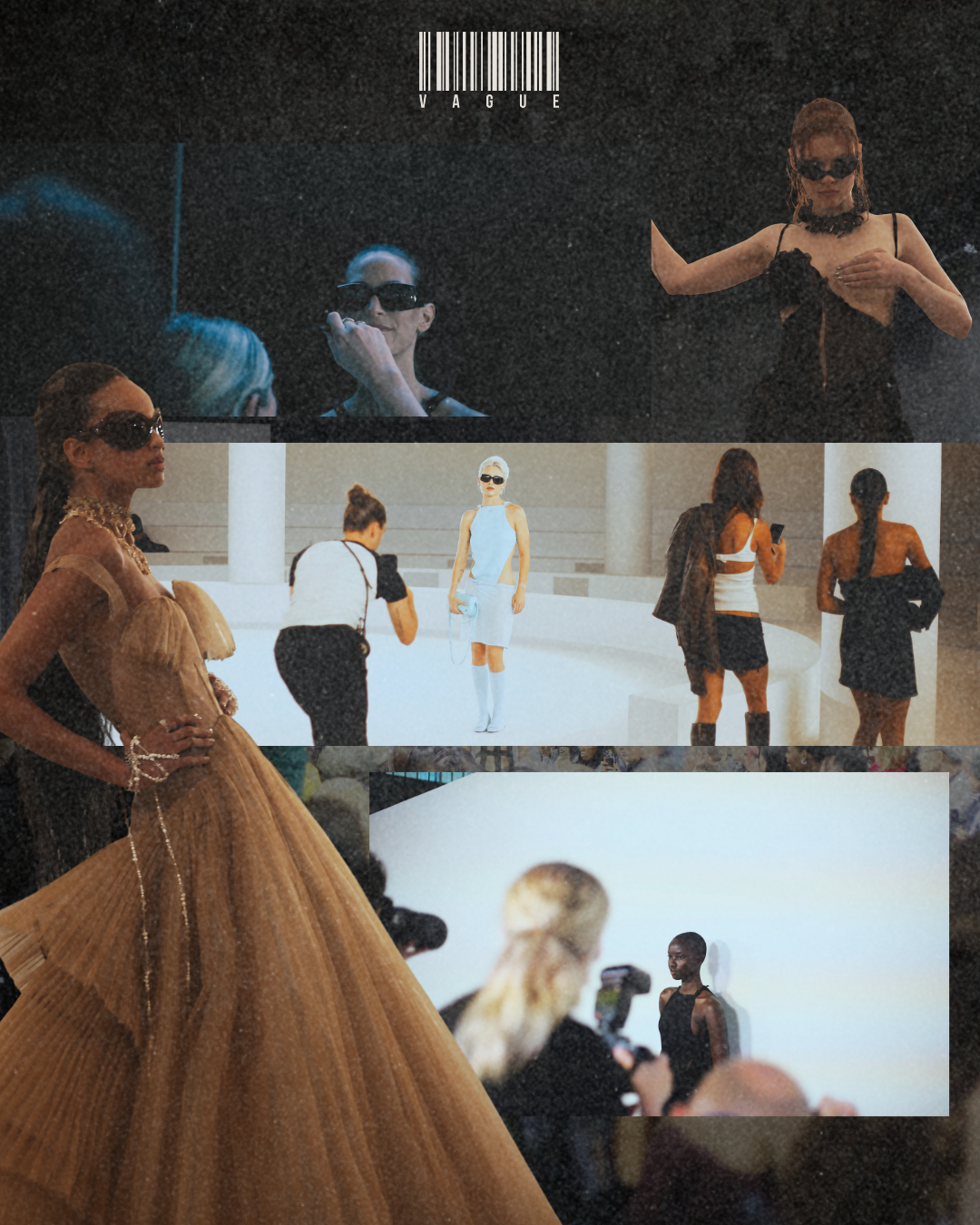
[Clockwise] SS26 collections by Courreges and Di Pietsa as seen by Karina So.
On the other side of Paris, the arrival of Pierpaolo Piccioli at Balenciaga offered a palette cleanser for fans of the house before 2016. His background in couture introduced a softer narrative — fringes, feathers and florals — to the current street-trench vocabulary Demna left behind, harking back to the maison’s salon roots. But can a house known for disruption find new vitality in refinement? According to the numbers, that’s next season’s problem with a record $881 million in earned media value reported for SS26 collections overall. Driven heavily by creative debuts and influencer-driven amplification, this proved that these leadership transitions aren’t just creative exercises; they’re commercial inflection points. Brands injecting new voices aren’t merely sending freshly adapted house codes down the runway; they’re staging culture and reaping lucrative rewards as a result.
And then we have Louise Trotter, whose debut at Bottega Veneta marked the only woman appointed to a major house’s top womenswear design role for SS26. Her collection doubled down on restraint and texture, and the result bordered on flawless. Fringe-tassel dresses, parachute silks and recycled fibreglass pointed to movement, tactility and a luxury reinterpreted through subtle subversion. In a season where many debuts leaned into logos, celebrity or theatrics (🗣️ Gaultier), Trotter’s approach steered the brand into new terrain without jettisoning the codes that have made it the cult-favourite it is today, famously without an Instagram feed of its own to boot.
But one might argue the stakes were much higher for her, given the optics. In addition to being one of two leading women in the CD arms race this season alongside Rachel Scott, she is also the first woman to hold the role since Laura Braggion in the 1980s, as well as the only female creative director leading a brand under Kering's fashion arm. In an industry obsessed with who sits where, despite her hard-earned qualifications at Carven and Lacoste to name but a few, being the only woman in the SS26 dragon’s den spotlight made her achievement both overdue and pivotal. The question is whether the collection will be read simply as “the new female designer at Bottega” or as the next chapter of a house whose narrative has been exceptionally reset by a historically under-represented talent.
“Brands injecting new voices aren’t merely sending freshly adapted house codes down the runway; they’re staging culture and reaping lucrative rewards as a result.”
If this season has any lesson, it’s that fashion is no longer just an object of desire: it’s a site of conversation. Affected by C-suite shifts or not, each collection this spring seemed to argue for its own cosmology, mapping out brand universes that could withstand scrutiny, signal clear intent and demand interpretation from an increasingly discerning audience attuned to the subtle interplay between aesthetic pleasure and cultural narrative. For these consumers, these pieces have transcended — or receded if we consider the economy — from status signals to vehicles for narrative.
In that sense, SS26 lived up to the hype of the cosmic reset it was made out to be with a rare convergence: legacy houses and independent auteurs finally spoke the same language, though from opposite ends of the spectrum. Whether they were working within the parameters of inheritance or constructing meaning from scratch, together, they reflected an industry wrestling with itself at the intersection of commerce and conviction. The collections this season didn’t just hand us the answers to the question of several house changing hands. They also gave us a peek into the future of these next‑gen brands too, and what might become of their impulse when they too reach maturation. And the future, it seems, is extremely bright.
credits
words — karina so.
photography — karina so.
design — gloria ukoh, karina so.