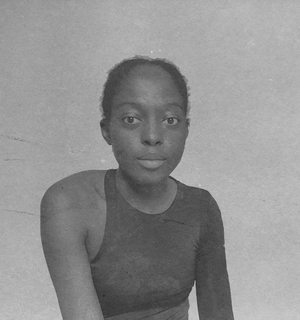
Sophie Mashraki built ANTISUPERMODEL on a small number carrying big dreams. Ahead of the petite modelling agency’s Berlin Fashion Week runway show, the model and founder talks industry height defaults, fashion's long history of casting toward vulnerability and why they'd rather stay niche.
There is a moment just before a casting starts that everyone present inherently understands the second a model walks in the room. Before words are exchanged or portfolio books opened, decisions have effectively been made at the door. No measuring tape needed. The “eyes” have it. This is the daily experience of the average petite model that has rarely been interrogated with the seriousness fashion reserves for, say, a waistline.
However incomplete, one could argue plus-size representation has had its industry reckoning — long, halting and in constant need of revisiting if this year’s presentations are anything to go by. Disability in fashion — the subject of VAGUE’s deep dive with former British Design Council CEO Minnie Moll in response to the V&A’s recent exhibition — is also starting to be considered a design requirement rather than an afterthought, finally. But height seems to sit underneath almost all of it, unquestioned; treated as a neutral fact of the industry rather than a constructed preference. And while this neutrality comes with less violent prejudice than the aforementioned marginalized communities are made to suffer, the fact still remains that tall, as far as fashion is concerned, is an exclusionary decision the industry made decades ago and never bothered to unpack.
Living between Paris, Berlin and Vienna, model Sophie Mashraki has built an agency on the argument that it should. ANTISUPERMODEL represents models under 165cm across Western Europe and beyond. Stylized in all capital letters, the name is its argument: not anti modelling, but anti the myth of what a model has to be. But where a simple campaign could’ve asked the industry to feel differently about how it casts its faces, starting an agency goes one step further to facilitate the thing the industry was never going to build on its own: representation, contracts, a roster, a system.
“[Tall] is a decision the industry made decades ago and never bothered to revisit.”
ANTISUPERMODEL’s 165cm line is deliberately, almost clinically specific; drawn not from convention but from Mashraki’s own observation of the human body, and the threshold below which it starts behaving like something the industry has never quite known what to do with. “All models under 1.74 — 1.75m are generally considered petite in the fashion industry,” they explain. “We chose to specifically work with models that are 1.65m or shorter because of their bone structure, proportions and body fat composition” — a body type, they argue, distinct from what the industry has lazily lumped together as “short.” It’s a finer-grained taxonomy than fashion is used to, and an important one for that very same fact. Precision of this nature works in direct defiance against letting “diversity” become its own kind of shortcut. Mashraki speaks candidly about having watched that shortcut happen from the inside as a former casting professional, working with brands reaching for what they call “the safe version of diversity” i.e. defaulting to the token lighter-skinned, biracial model. “It simply bores me.”
With ANTISUPERMODEL however, Sophie didn’t set out to write a manifesto. They simply drafted, in their words, “a list of why petite models are relevant in the industry” — half practical, half provocation; the kind of inventory you make when you’ve decided a gap in the market is also a gap in the imagination. “Short people also wear clothes,” they say. “Yet, [they] have different proportions to tall people, so there's a fully missing market for not just petite representation, but also petite fashion.”
This opportunity gap echoes the rise of the original anti-model Kate Moss, arriving into the glamazon era of the late 80s as something smaller, stranger, more relatable perhaps than the women around her. “We want our models to be authentic, raw and a possible alternative to what the fashion industry currently considers supermodels,” Mashraki says of the agency’s talent roster. “Whether those are nepo babies, underweight tall girls in their late teens, or, well, just the standard face you sort of see everywhere.” For them, height simply represents an unfinished idea. And thus, the agency’s roster offers “a different body type and bone structure not yet fully lived out to its potential in fashion.” In that regard, the term ANTISUPERMODEL goes beyond being a brand; it’s a sense of politics “by the people, for the people.”
Ask Mashraki where the industry’s height obsession even comes from and they’ll give you two answers, stacked. The first is logistical: longer, leaner lines are simply easier to standardize than the variance of a globally representative population of bodies. This insight has a traceable lineage in the postwar runway shape, built for distance viewing and dramatic silhouettes, and the rise of the sample size as a production shorthand. The Supermodel era of the 80s and 90s — Cindy Crawford, Christy Turlington, Naomi Campbell, each one poised above 5’9” — then cemented the gait and drape of height as a visual symbol of power.
The practical defence has always been that clothes ‘hang better’ on longer lines. “Tall bodies tend to have fewer curves from the way that they’re built,” Mashraki says. “Especially when the models are very, very skinny. So it’s easier for a designer to create a sample size wardrobe rather than accommodate to the natural fluctuations and diversity of every body.” It’s a convenient story, because it forecloses the more uncomfortable one: that tall reads as aspirational, and aspirational has always meant unreachable. A runway built for people to look up at, literally.
But Mashraki’s second provision for the tall default is the one fashion loves to leave out of its own retrospectives. “I would personally argue that it is also a racist, supremacist concept,” they explain, pointing to the statistical reality that average heights vary by ancestry so a standard calibrated to one specific population was never neutral to begin with; a truth that sits outside the industry’s preferred story about itself.
That very same Supermodel era wasn’t the high point everyone remembers it to be but rather the catalyst for a correction against models who had become too powerful to control. See: the famous refusal of the Linda Evangelista generation to “wake up for less than $10,000 a day.” But as Mashraki notes, “fashion can’t really prosper when someone’s fame becomes more important than the fashion itself.”
“So it’s easier for a designer to create a sample size wardrobe rather than accommodate to the natural fluctuations and diversity of every body.”
What followed, in their telling, was a market response known as the ‘Slavic Doll’ era: casting toward malleability rather than charisma; toward girls “from war-torn [Eastern European] countries” — young, broke, vulnerable and disenfranchised. Drawing similarities between the power dynamics of the Epstein scandal that often targeted that very same demographic, the underlying claim is one labour historians of the industry have made for years: that fashion's casting patterns often trace not beauty but socio-economic vulnerability, and that the decades most celebrated for having a “look” were frequently those least equipped to ask what that look cost the people wearing it. For Mashraki, the answer is human decency.
Fast forward to present day, Mashraki is notably uninterested in relitigating whether tall should still be considered aspirational. “It's the difference between whether you sit comfortably on a toilet, have to sniff someone's raised armpit on the subway, or miss out on the theatre experience you paid for because a tall person is blocking your view,” they say, with the kind of deadpan humour that refuses to dignify a question with more gravity than it deserves. Whether the industry has actually changed or merely improved its vocabulary isn't, to them, the most productive question. “It is up to us to cement trends that we care about,” they declare. “Not be victims of an industry that itself adapts to popular demand.”
In a similar vein, Mashraki is unsentimental about the mechanics of exclusion, having watched casting directors warm to taller models in a room while they sat unacknowledged as a model themselves. "But the joke was on them," they laughed, because the designer had personally requested them. But in all this posturing behind the veil, what’s more interesting is how it manifests outside the industry entirely: everyday people outside the industry, they say, rarely register their height as disqualifying. “They even ask me if I model,” They say. “And I sort of stop with surprise — like, I am short, why would you think that? But they do.” Conversations like these suggest the height ceiling isn't the cultural consensus we’ve been led to believe, but rather an internal industry superstition the rest of the world it fundamentally serves never actually subscribed to. ANTISUPERMODEL’s casting requirements therefore does the same work in reverse that the industry's unspoken tall-default has always done: it draws a boundary, but this time out in the open, daring you to ask why.
As we continue to probe each of the load-bearing walls of this house of cards, Mashraki resists the idea that petite models carry shame about their height so much as “regret… that they are missing out on chances based on their height.” And they’re just as firm about what inclusion without redesign actually produces. Inclusivity has, in recent years, become fashion's most fluent language, despite also being its least binding promise. The industry has gotten good at the gesture — one casting choice, one campaign cycle — without so much as glancing at the architecture underneath: the samples, the briefs, the assumptions.
When asked what brands consistently get wrong in their inclusivity efforts, Mashraski’s answer is both blunt and all-encompassing: “when the clothes do not fit the person.” Petite isn't a proportionally scaled-down template, they insist: different bone structure equals different fat distribution equals different results on the body entirely. Dressing a petite model in a sample built for someone 15cm taller is no more inclusion than a category error. There’s a meaningful difference between being included in a casting and having one built to include you; between a brand that adds a petite model to a lineup, and a brand that designs as if they were always supposed to be there.
But where one might expect Mashraki to argue for petite's arrival into the mainstream, they decline the premise entirely. “Is it really bad that petite models are a niche?” They ask. “I don't quite mind being a minority in fashion, as long as we are part of the conversation” — not folded into the industry's diversity language, but present as “a viable and visual market.” Mainstream, in their account, is where fashion houses go to die. But niche, held on your own terms, is leverage.
The question Mashraki has spent the better part of their multi-faceted career asking isn't whether a model meets the number, but why that number got to decide in the first place. But success, for them, isn't a booking count but the cultural weight of becoming an agency known for “strong views on model safety, compassion, politics to a certain extent, and change in society,” with models recognized as more than the measurements that got them in the room.
And the next chapter in that story arrives on July 4, 2026, at Berlin Fashion Week, under a loaded title that points to the weight and responsibility of knowing: Garden of Eden, where Eve eats the apple. A biblical story memorialized for its verdict on femininity, curiosity and the danger of wanting more, Mashraki's invitation is characteristically unbothered by ceremony: "Come watch."
credits
voice — sophie mashraki
words — karina so.
design — gloria ukoh