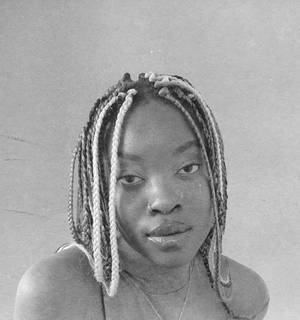
Hair has never been neutral for women of colour.
Whether kinky or curly, our hair spirals through multiple functions at any one time: as evidence, as provocation, as permission slip, as liability. For Black and Brown women in particular, hair is often read long before the mouth speaks: disciplined or unruly, respectable or resistant, feminine or defiant. It is regulated in schools and workplaces, fetishised in popular culture, politicized in protest, and pathologized in communities. Each strand carries centuries of history, both possessed and prescribed, so to style it, cut it, cover it or shave it entirely has always carried consequences far beyond aesthetics.
This VAGUE original emerges from that inheritance. It builds on the premise that hair is not simply personal but structural: shaped by colonial hierarchies, racialized beauty standards and gendered expectations of care, softness and presence. For some, hair is a site of pride and continuity, braided through lineage and ritual. But for others, it is a source of fatigue, surveillance or pain. For those who choose to shave their heads, the act reads not as absence but as agency: a refusal of expectation, a reclaiming of time, a redrawing of intimacy with the self.
Built from audio voice notes recorded remotely, Our Hair assembles fragments of lived experience into a visual found poem. Voices overlap, interrupt and echo, resisting the neatness of testimony in favour of something closer to communion. Produced remotely between London and Lisbon, the film reflects the contemporary conditions under which intimacy now circulates: mediated, dispersed, synchronized, yet no less real.
By cutting together voices across geographies and experiences, VAGUE Residents Ayomide Abolaji and James Olusegun build shared terrain — and hair becomes a shared language spoken in many dialects: grief, relief, pride, resentment, pleasure, exhaustion. Through confessionals filmed in bedrooms and outside, the poem presents our hair as weight and freedom, shield and exposure; documenting the ongoing negotiation women of colour conduct in both public and private spaces, and presenting it as a chorus of mutual frustration and paradoxical celebration.
“It’s not just my hair; it’s not just your hair,” says creative director Ayomide. “It’s our hair.”
credits
voices — ema reis, evianne suen, mitzi okou, marina kanza, avanthika iyengar
faces — amira, maro, khyati sri gudideni, aliyah, sathya bargach
creative direction, poetry, sound design — ayomide abolaji
music composition — andre mancio
filmmaker — james olusegun
art direction, words — karina so.
design — gloria ukoh