
The Mediator Between the Head & Hands Must Be the Heart
Fritz Lang’s Metropolis gave us a city split between those who think and those who toil and a female cyborg caught in between. VAGUE Resident Daisy asks how much has really changed.
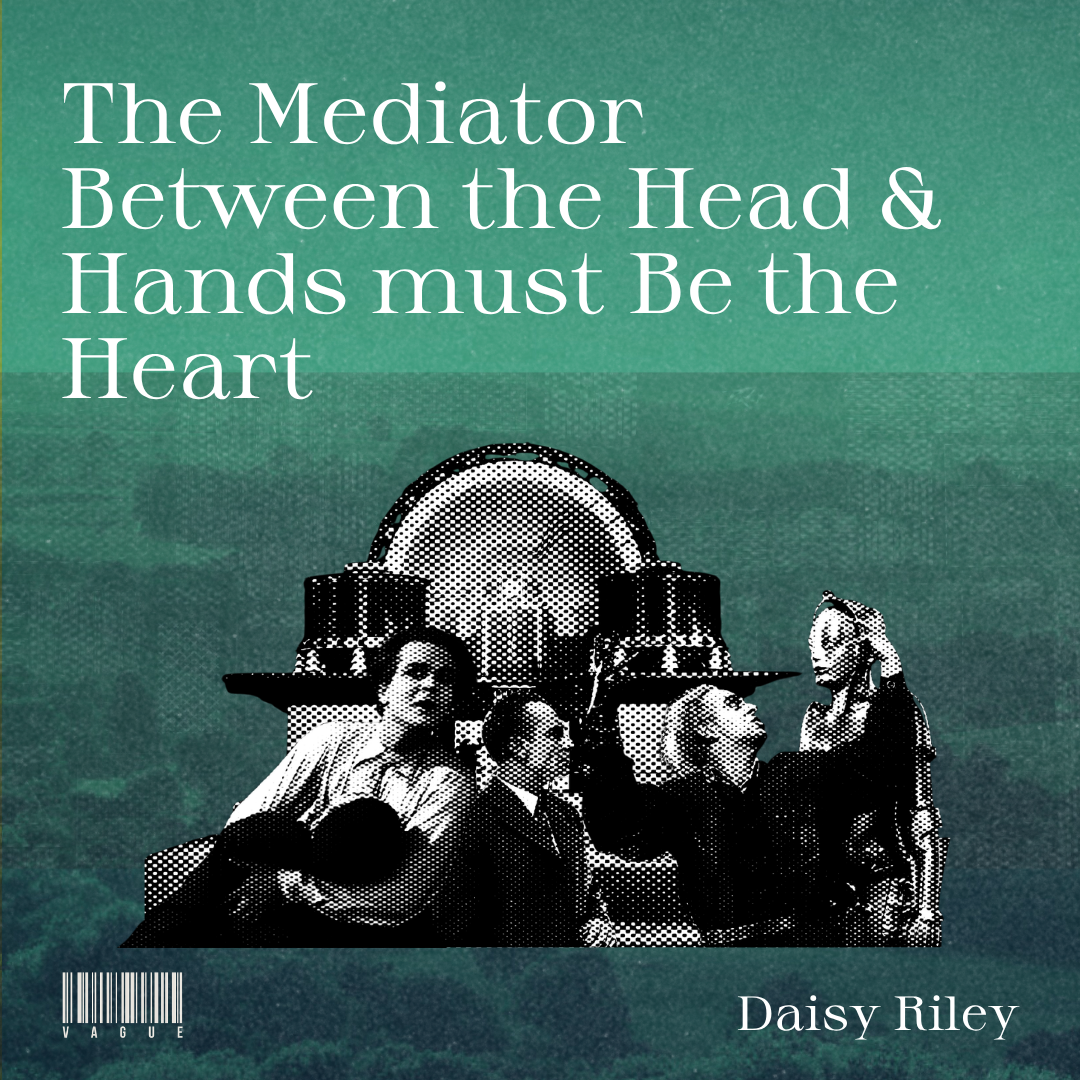
If you haven’t seen Fritz Lang’s 1927 science-fiction masterpiece ‘Metropolis’, maybe you never need to - you’re already living it.
A major flop at its initial release 100 years ago, the silent movie has become a cult classic. With stunning set building, enchanting 1920s VFX and some of the most beautiful art deco promotional posters ever it’s no wonder that film nerds today love it. The fact that it wasn’t appreciated in its own time?! Bonus.
But there’s another part of the film that is particularly sinking its robotic fingers into our minds. As a science fiction it’s set in what was at the time a distant and mysterious future, the year 2026. Not only that but the key technology that drives the plot of the movie is the very first on-screen depiction of artificial intelligence.
AI now permeates our jobs, our art, our education and even our couture fashion. Whether purposefully imitating the aesthetic of Metropolis, or whether Lang happened upon an uncannily accurate premonition - we can see the dark, smoky world of Metropolis seeping into the present.
“...whether Lang happened upon an uncannily accurate premonition - we can see the dark, smoky world of Metropolis seeping into the present.”
Technological advancement, without emotional growth.
The very first line that opens the film describes the shocking domination of today's 1% - “In 2026 the total oppression and manipulation of the masses is exercised by the unquestionable power of a minority.”
In the dirty, unsafe underworld of the lower classes, workers toil, namelessly interchangeable - they are the ‘hands’ that keep the city whirring. Above, in the vertical city in the sky the upper classes' leisure, known as the ‘brain’, they enjoy planning, controlling resources or gallivanting in the pleasure gardens.
Parametric Archeticture’s Isha Chaundry explores this further, ‘This vertical structure was deliberate. It visualized a strict hierarchy. The city runs smoothly because labor is hidden.’
Set in an eerily spot on version of 2026 where the hedonistic elite don’t even acknowledge the struggles of the lower classes, Metropolis follows a young elite son discover the strife of the ‘hands’ and fall in love with their prophet and activist leader - Maria. As he seeks to unify the city his father commissions the building of an Android, able to learn and mirror Maria, to foil his plans.
To do the plot and its visuals no justice at all (spoilers ahead) the real Maria and her love encourage mediation, unity and peace. Whilst the Robot (under control of the elite who made her) encourages disruption, class warfare and ultimately a catastrophic and destructive revolution.
A key idea within the narrative is that the complete separation of ‘brain’ and ‘hands’ is dangerous. But the introduction of the robot is an early provocation theorised on by many a scholar since - the idea that technology is ‘morally neutral but politically dangerous.’
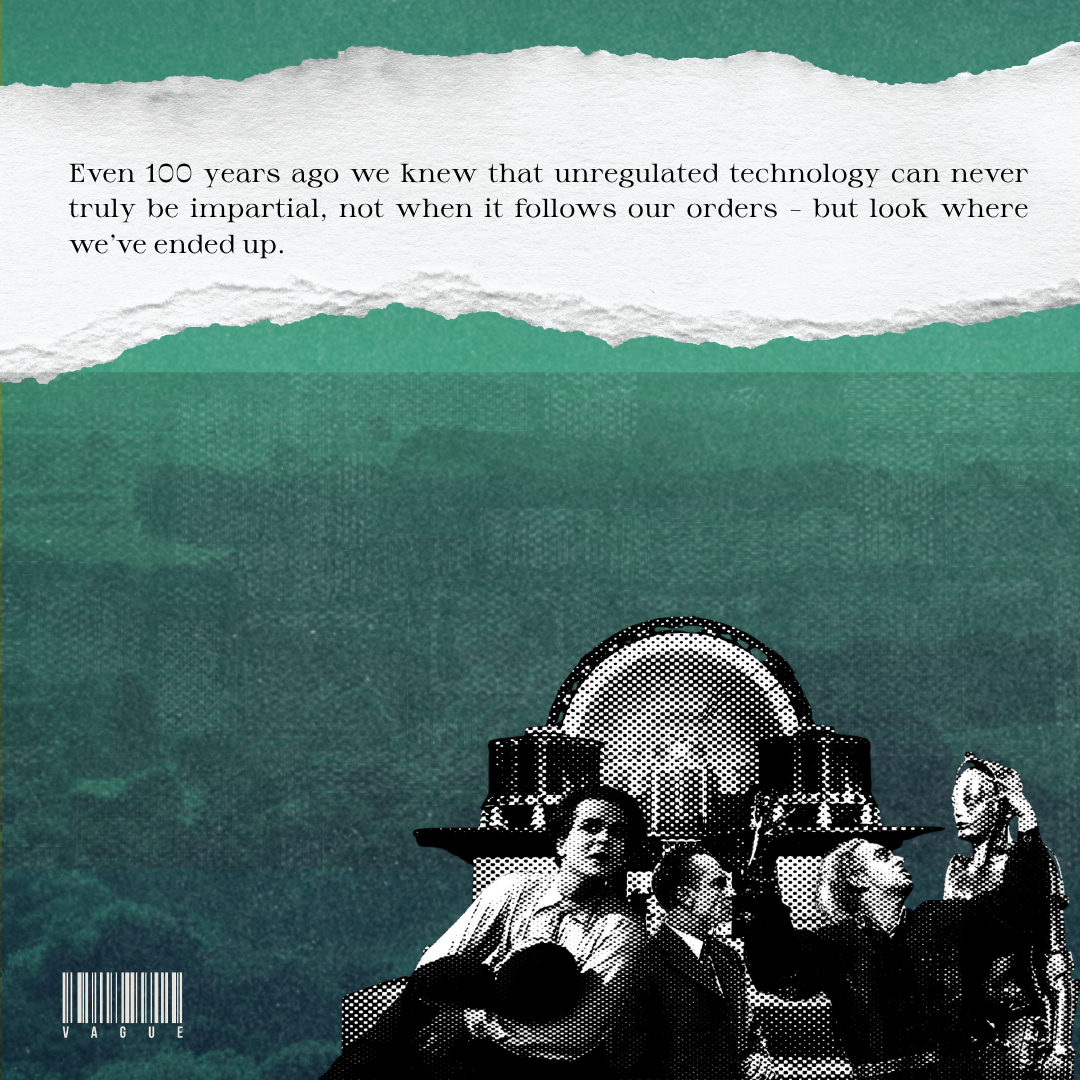
AI controlled by the rich creating discord between classes and stoking more fall out? It’s an allegorical plot someone could have literally sent to Netflix last week. Even 100 years ago we knew that unregulated technology can never truly be impartial, not when it follows our orders – but look where we’ve ended up.
The film’s focus on the divide between the ‘brain’ and the ‘hands’ as just as insightful as the cultural class divide it depicts, with anatomical descriptions giving us another pause for thought on the divide we all hold between our desires, dreams and genuine beliefs held in our brains - versus the menial work, thoughtless actions or dangerous inaction that our hands carry on.
"She is the most perfect and most obedient tool which mankind ever possessed!"
When instructing the architect to build the Robot in Maria’s likeness, we are given the famous line "Give the Machine-Man the likeness of the girl." Why a woman? Whilst some forms of technology are very linked to masculine endeavours, and almost all the billionaires who profit from technology services are men, there is one category of technology that consistently falls into a female personification - that which forms a subservient role.
The power held by this particular robot leads to debate - is it a powerful woman figure, or a glorified assistant?
Cyborgism has long been perceived by xenofeminists and writers as a potential portal to gender-freedom. Donna Haraway's concept of the cyborg as a trans-human vessel and space for political progress is explored in her seminal essay ‘A Cyborg Manifesto’. She notes that cyborgism by no means entails subservience but instead offers new possibilities to humanity. She recognised us all as cyborgs due to the entanglement of technology throughout our daily lives, and whilst recognising this as a potentially oppressive force sees the cyborg as something of an illegitimate child, with an inherent unruly nature that makes it able to run riot and subvert the order that it lives within.
She also uses the metaphor of the cyborg to challenge traditional ideas about gender and identity. Haraway argues that categories like male and female, which have long defined gender roles, are becoming outdated in a world increasingly shaped by technology and blurred boundaries between humans and machines. (The Grey Zine)
But this is a feminist looking towards the 90s with hope, and eyes wide with potential. The Robot is a tool created by men with specific goals in mind. In their own words they seek obedience, using the female image, and all the stereotypes placed upon it, to wreak havoc without blame.
‘The robot has female features, seductive, persuasive. It does not work: it communicates. It does not produce: it orients. It is engineered to fascinate, to stir, to influence the masses. Its power is not coercive but charismatic. It seduces, excites, and speaks to emotions. It is built to be believed, not to be true. In this sense it is the direct ancestor of digital avatars, virtual influencers, artificial intelligences designed to simulate empathy and steer behavior. Lang had already understood that the most effective domination is not the one that commands, but the one that captivates.’ (Silvana Annicchiarico, Domus)
Dare we call it - the first AI influencer?
“The power held by this particular robot leads to debate - is it a powerful woman figure, or a glorified assistant? ”
Fashioning the she-cyborg.
Metropolis has had a huge creative impact on the real 2026 too, and the aesthetics we associate with robots.
Her hyper-feminine shape, flashes of chrome, and metallic bodice have been echoed through Mugler runways, whilst the smoky New York inspired sky scraper city of Metropolis has formed the backdrop to photos by Helmut Newton, and echoes of its influence have either been evident or cited in collections by Tom Ford, shoots by Karl Lagerfeld, and iconic media like Blade Runner or The Fifth Element.
Meanwhile, AI is no longer just an inspiration for fashion, but is cited as couture, whilst digital designers pop up across the internet. Again, with a naive optimism new designers as claiming digital fashion as more inclusive, more accessible and more sustainable - but with the heavy environmental impact of data centres, the maintained lack of runway representation and introduction of AI models taking work from real people. It’s clear that once again a distinct separation between ‘brain’ and ‘hands’ means we’ve built something we can’t actually live in.
Instead of becoming artificially created clothing ‘Cyborg-themed fashion could subvert traditional fashion roles by mixing unexpected materials, structures, or styles that defy categorization. For instance, garments that are modular, adaptable, or customizable could symbolize the cyborg’s ability to transform and resist fixed identities, echoing Haraway’s critique of stable, essentialist views of gender and identity’ (The Grey Zine) whilst also opening fashion up for those with disabilities, or for whom modular designs could result in more sustainable repair over replacement.
“...AI is no longer just an inspiration for fashion, but is cited as couture, whilst digital designers pop up across the internet.”
With all that promise, why are we still falling into a dystopia?
The running message between today's digital fashion and creative scene, the gendered roles of our technology and the story of Metropolis is that good intentions aren’t good enough. Outsourcing that which makes us human (emotional reasoning, creativity and unity) will never lead us to our salvation. Chasing the progress of technology without inclusion of the basic foundation of empathy will only ever lead to chaos.
In the film ‘Decisions are taken by opaque systems. Avatars speak with human voices, but answer to non-human logic. The robot of Metropolis is not a past mistake: it is a warning…. exactly one hundred years later, the question remains unanswered: who governs the intelligence that governs us?’ (Domus)
Or, in the direct closing words of Metropolis - “The mediator between head and hands must be the heart".
credits
words — daisy riley
design — gloria ukoh