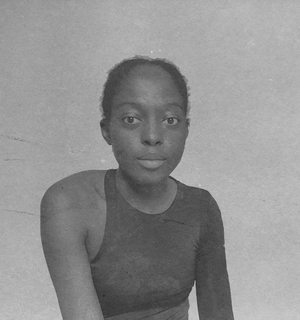
For this month’s cover story, VAGUE CREW Lead Karina comments on the burdens that come with the coily and curly crowns atop the heads of Black and Brown Women, with creative led by Ayomide Abolaji.
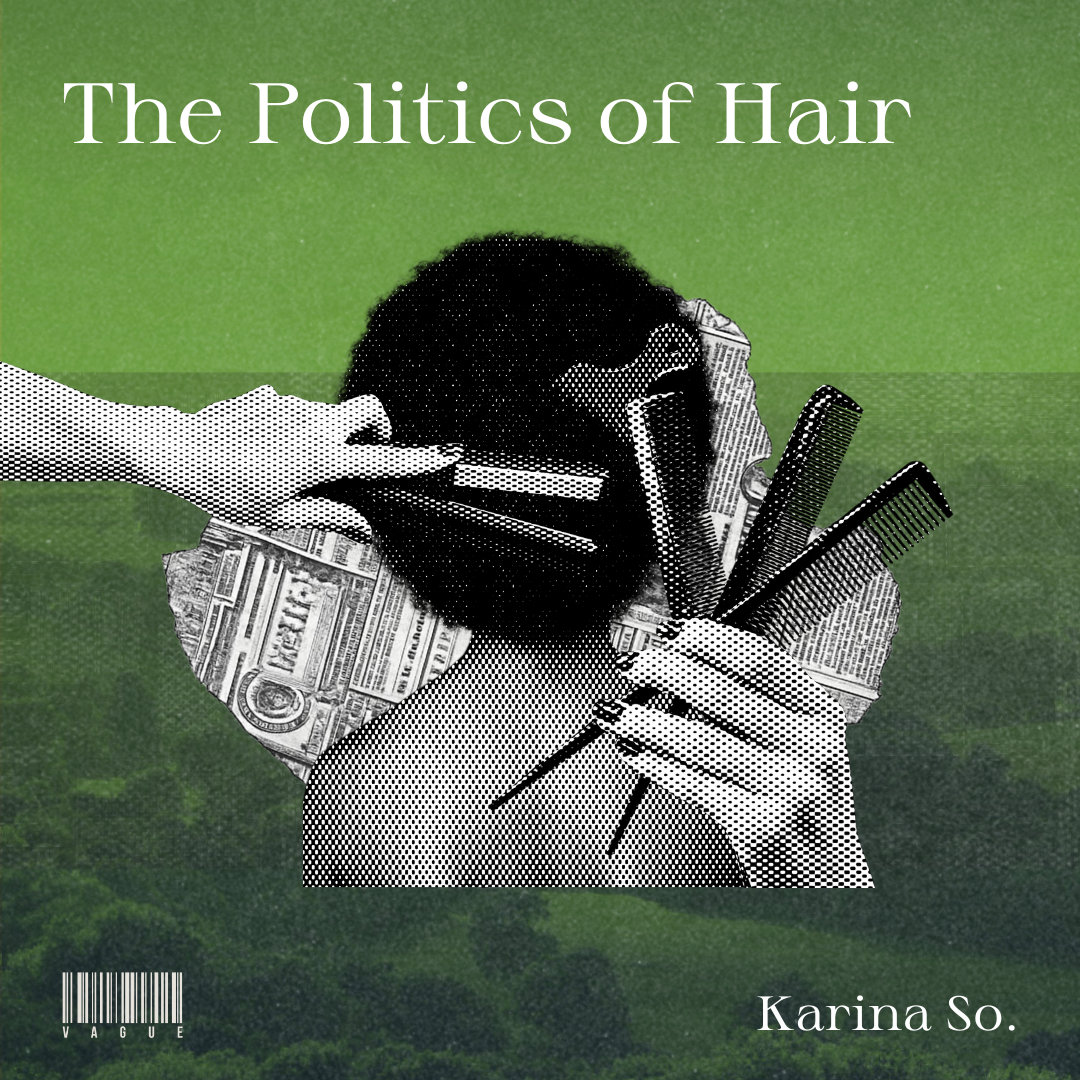
Hair is never just hair.
For Black and Brown women, it enters rooms before we do. It is heard before we speak and measured against rules we did not write, in institutions we did not design, by people who insist the consequence is neutral.
Archive.
Battleground.
Evidence.
Resume.
From early childhood, hair becomes one of the first ways Black and Brown girls learn that their bodies exist for public consumption. Unshielded by the delayed gratification of puberty, the scalp is politicised bright and early. Fingers tug. Aunties comment. Teachers discipline. And later, employers policy. Lovers fetishize. Strangers graze. As we age, so does the world’s appetite for hair that does not belong to it.
In Western society, this tension comes with expectations of legibility. Our hair must make sense to systems built around whiteness as default. Straightened, relaxed, pressed, silk-wrapped.
“Professional.”
“Neat.”
“Appropriate.”
These words, masquerading as adjectives actually enforce increasingly global codes of conduct. Not about hygiene or personal care, but about proximity to whiteness, to compliance, conformity and ease of consumption. No longer do these messages need to be explicit, as enough time has passed to establish acceptable etiquette. Today, the violence has softened its voice, trading bans for bias and discipline for “feedback.” But the result is always the same ongoing negotiation between identity and survival.
We see this play out repeatedly on red carpets that claim progress while rehearsing old discomforts. When Wunmi Mosaku brought irun kiko to the Golden Globes, the first sighting of the traditional, often disparaged threaded hairstyle on a red carpet, the look circulated traditional media outlets with fascination and oversimplification. Coverage lingered not on craft, lineage or meaning, but on translation to Eurocentric standards of glamour and beauty. The soft-pedalling, however unintentional, was familiar: this is beautiful, but foreign; powerful, but in need of interpretation.
Contrast this with how often everyday Black women’s hair is praised only once it aligns with Eurocentric ideals. The slick bun. The bone-straight middle part. The “clean girl” aesthetic, which quietly borrows quintessentially Black techniques yet rewards non-Black bodies for wearing them. The same hairstyles that trigger school suspensions or workplace reprimands become trend as soon as they are detached from Blackness.
The beauty industry has also responded with language that sounds like support but functions as containment.
“Taming.”
“Managing.”
“Control.”
Even the natural hair movement, radical in its inception, has evolved into social stratification systems that still police texture. Looser curls are celebrated. Kinks remain “difficult”; shrinkage, framed as a problem. Length becomes currency again, as though liberation must still flip over shoulders to be valid.
For Brown women across South Asian, Middle Eastern, North African and Afro-Latina communities, the pressures fracture differently but the logic is the same. At home, hair must signal respectability, femininity, tradition. Outside, it must not be too much.
Too thick.
Too dark.
Too “ethnic.”
The struggle is constant: straighten to be legible in the world, oil and braid to remain legible at home. This split consciousness produces its own quiet violences in the form of heat damage disguised as discipline, tender scalps framed as softness and the internalised belief that hair must be fixed before life can begin. Weddings. Jobs. Photos. All delayed until the hair is “right.”
“Even the natural hair movement, radical in its inception, has evolved into social stratification systems that still police texture.”
Social media promised release but often reproduces the same hierarchies at scale. Algorithms reward a narrow band of beauty. Tutorials flatten cultural specificity into consumable steps. “Slick back” becomes universal instruction, erasing the fact that slickness is not neutral, and that for many Black women it is a survival tactic learned under scrutiny. Even moments of apparent celebration reveal fault lines. When Zendaya debuted on the Oscars red carpet with long black locs in 2015, the backlash was swift and telling. Today, locs appear more frequently in fashion editorials and popular media, yet the question remains: who is allowed to wear them without consequence? Who gets to remove them without penalty? Who is asked to explain their hair as political and who gets to wear it as aesthetic?
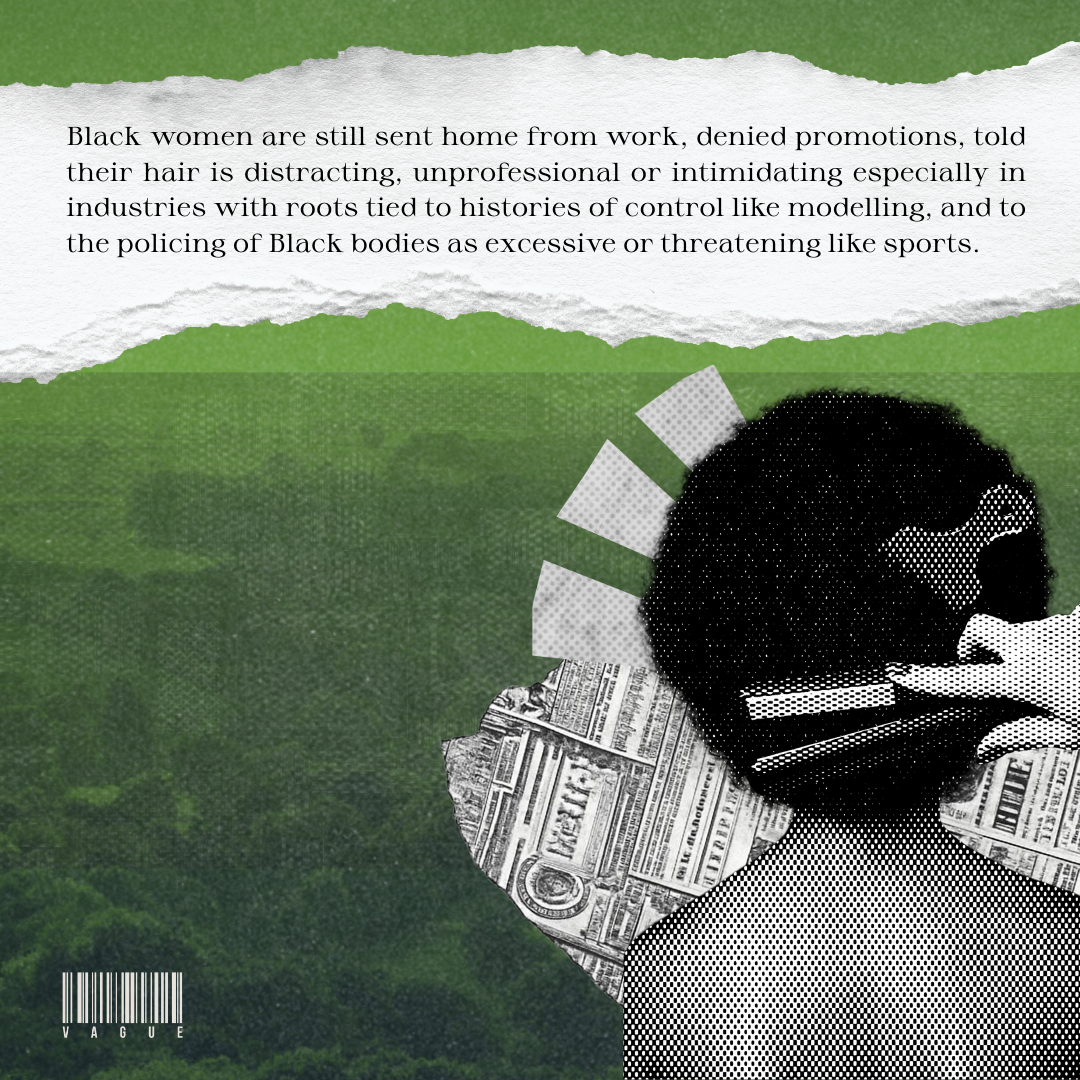
Legislation around hair discrimination, like the CROWN Act in the US, exists because the issue is anything but symbolic. Black women are still sent home from work, denied promotions, told their hair is distracting, unprofessional or intimidating especially in industries with roots tied to histories of control like modelling, and to the policing of Black bodies as excessive or threatening like sports. What makes the pressure so insidious is that it asks Black and Brown women to be grateful for our conditional acceptance. You can be here, but not fully. You can be visible, but curated. Be yourself, but edited and hair is too often the line item where that editing begins.
And yet, even within these overwhelming constraints, hair continues to hold joy. Creativity. Ceremony. Braiding as intimacy. Wash day as ritual. Salon confessionals. Kitchen chair communions, where techniques pass from hand to hand, generation to generation. Even our pain is communalized, laughed through memes and TikTok vlogs. In recent years, more women have used public platforms to connect through the turmoil and that is exactly what this month’s cover story set out to achieve.
With Our Hair, VAGUE Resident Ayomide introduces an old conversation many have been forced to carry alone in a novel format produced between London and Lisbon as we in the STUDIO wonder why Black and Brown women continue to be subjected to judgment about something that grows naturally out of our heads. Wild.
credits
creative direction — ayomide abolaji
words — karina so.
design — gloria ukoh